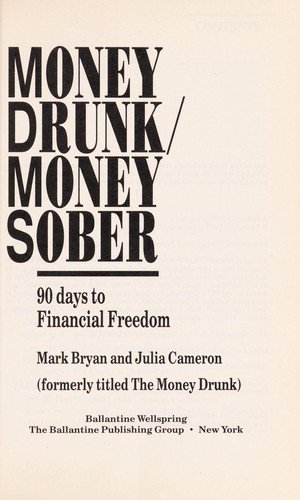
In 1992, the same year he published The Artist's Path, Julia Cameron published another book that — although much less famous — lays the conceptual foundation for much of her thinking about money. He co-wrote it with Mark Bryan, his collaborator in creative recovery workshops. It is titled Money Drunk, Money Sober: 90 Days to Financial Freedom. The premise is radical for the time: many people do not have a financial problem, they have a money addiction — to spend it, to accumulate it, to avoid it, to despise it. And that addiction is treated like the others: with steps, with structure, with time, with honesty.
book summary
- Year: 1992.
- Co-author: Mark Bryan.
- Structure: 90 days divided into phases, with daily exercises.
- Conceptual framework: adaptation of the logic of the 12 steps to financial behavior.
- The 8 types of "money drunk": the compulsive spender, the compulsive debtor, the compulsive saver, the compulsive moneymaker (workaholic), the avoider, the martyr, the tax cheat, the poverty addict.
- Who is it for: people with compulsive or evasive financial behaviors that are not resolved with rational financial advice.
The central idea
The authors argue that just as there are eight types of emotional "drunks" — perfectionistic, complacent, avoidant — there are eight types of money drunk. Each type has a specific pattern that repeats regardless of income level. A compulsive spender is still a compulsive spender whether he earns 20,000 or 200,000 a year — he will only spend proportionally. A poverty addict will remain poor even if he receives an inheritance—he will squander it or reject it to return to the state with which he is familiar.
The three problems of all types: (1) are unconscious, (2) are learned loyalties in the family of origin, (3) sabotage relationships and creative projects. The book is dedicated to making them aware and proposing the 90 days of "sobriety" applied to each one.
The 90 days
The program is structured in three 30-day phases. The first phase is diagnosis: Identify exactly what type of money drunk you are (or combination of types), what family history produced it, what triggers activate it. The second phase is behavioral withdrawal: if you are a spender, a month without non-essential purchases; if you are avoidant, a month looking at the accounts every day; If you are a compulsive saver, spend a month deliberately buying things that are good for you. The third phase is integration: build a new sustainable financial behavior based on the sobriety of the second phase.
Cameron and Bryan insist that the 90 days are not a magic solution. Are the beginning. Financial sobriety, like emotional sobriety, is a lifelong practice. What the 90 days give is not healing — they give the ability to see the pattern and the experience that it can be temporarily broken. That's enough to get started.
"The relationship with money is the relationship with value. Change one — change the other."
Cameron and Bryan · Money Drunk, Money Sober · 1992Why has almost no one read it?
The book, although it has remained in the catalog for more than thirty years, has never reached even one-hundredth of the sales of The Artist's Path. The reasons are several. First: it came out the same year and was eclipsed. Second: the "money book" market is saturated and Money Drunk didn't fit cleanly — it was too spiritual for the finance section, too financial for the self-help section. Third: co-authorship with Bryan diluted the Cameron brand.
But among those who do read it — frequently recommended by addiction therapists — it is often a discovery. Many people identify for the first time, reading it, what their dominant pattern is. And that identification alone already changes things.
For whom?
If you suspect that your relationship with money is compulsive — too much spending, too much saving, too much avoiding, too much obsessing — this book will give you more clarity than fifteen conventional financial education books. If your problem is purely technical (not knowing which fund to invest in), look for another book. This goes to the layers below.
Bilingual technical data sheet · Technical data
English edition
Publisher: Ballantine Books (originally); Tarcher (reissues)
Year: 1992
Pages: 224
ISBN: 978-0345432629
Language: English
Spanish edition
Editorial: editions in Spanish according to publisher
Year: 1992 (original); translation available in various editions.
Pages: 224 (approx.)
Spanish translation: available from multiple publishers.
Language: Castilian
Historical context · Historical context
Cameron co-wrote this book with Mark Bryan, his collaborator in creative recovery workshops during the 80s. It came out the same year as The Artist's Way — 1992 — but was overshadowed by the overwhelming success of the first. Still, among addiction therapists and in recovery communities, Money Drunk, Money Sober has become a frequently cited reference book.
The eight types of "money drunk" · The eight types
- The compulsive spender · The compulsive buyer — spends due to anxiety.
- The compulsive debtor · The compulsive debtor — owes structurally, even with income.
- The compulsive saver · The obsessive saver — accumulates without enjoying.
- The compulsive moneymaker · The financial workaholic — works compulsively for money.
- The avoider — does not look at statements, does not sign papers.
- The martyr · The martyr — spends on others until exhaustion.
- The cheat · The cheater — evade, deceive, take shortcuts.
- The poverty addict · The poverty addict — maintains poverty as an identity even if he earns more.
Each type has a specific pattern, independent of income level. The authors propose 90 structured days: diagnosis, behavioral withdrawal, and reconstruction.
Frequently Asked Questions · Frequently Asked Questions
Is it a 12 step program? / Is it a 12-step program?
It is inspired by the 12 steps but is not a formal program. Uses step logic (diagnosis, acceptance, withdrawal, reconstruction) applied specifically to financial behavior.
Does it work for all income levels? / Does it work at all income levels?
Yes. The authors are clear: the emotional pattern is independent of income level. A compulsive spender continues to be one with 20,000 or 200,000 a year.
Is there a translation into Spanish? / Spanish translation?
There have been several editions in Spanish with different titles. Search for 'Money Drunk Money Sober' or 'Money Addiction' in digital bookstores.
Is it only useful for people with serious problems? / Only for severe problems?
No. Almost everyone recognizes one of the eight types in themselves on a small scale. The book works for even minor adjustments.
Is it related to The Prosperous Heart? / Relation to The Prosperous Heart?
They are complementary. Money Drunk (1992) focuses on specific toxic patterns. The Prosperous Heart (2011) is broader: general relationship with money and prosperity as an emotional state.
Bilingual glossary · Bilingual glossary of key terms
| English | Spanish | Meaning |
|---|---|---|
| Money drunk | Drunk on money | Compulsive behavior with money — generic for all 8 types. |
| Money sovereign | sober with money | State of conscious and calibrated consciousness. |
| Compulsive spender | compulsive buyer | Spend out of anxiety, not out of necessity. |
| Compulsive saver | obsessive saver | Accumulate without enjoying. |
| Poverty addict | Addicted to poverty | It maintains poverty as an identity even if income increases. |
| financial bottom | financial background | Moment of forced clarity on the boss himself. |
| Money detox | Financial detox | Period of abstinence from compulsive behavior. |
| financial integrity | financial integrity | Coherence between values and spending. |
| 90 days | 90 days | Structured duration of the program. |
| Bryan/Cameron method | Bryan/Cameron Method | Shared authorship — rare in Cameron's corpus. |
How to get the book · How to get the book
- Original English edition: Money Drunk, Money Sober: 90 Days to Financial Freedom. Available from Penguin Random House, Amazon, Apple Books, and Barnes & Noble. Also in independent bookstores and public libraries in the United States, United Kingdom, Canada and Australia.
- Spanish edition: Money Drunk, Money Sober: 90 Days to Financial Freedom. Search in general bookstores (Casa del Libro, FNAC, El Corte Inglés), on Amazon Spain/Latin America and in independent bookstores. Also available in digital format (Kindle, Kobo, Apple Books).
- Audiobook: Most of Julia Cameron's books have an audiobook version on Audible (English) and some editions on Storytel (Spanish).
- Libraries: Cameron's works are in most Spanish-speaking public libraries with a digital lending service (eBiblio in Spain, BiblioBoard in Latin America).
- Second hand: IberLibro, AbeBooks, Wallapop and eBay usually have used copies at better prices. For out-of-print books, it is sometimes the only way.
Take the complete Artist's Path course
Based on the original book by Julia Cameron. 12 structured weeks. Free. In Spanish.
Start the course