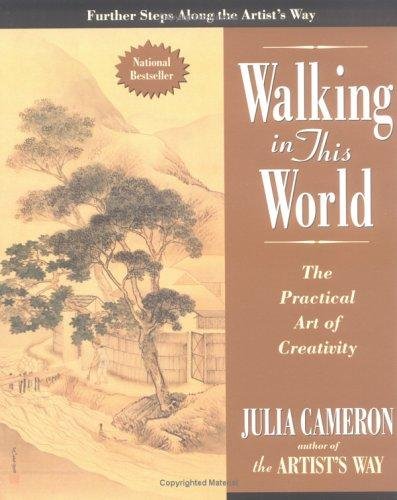
Between 1992 and 2002, Julia Cameron published more than a dozen books. No one was trying to be the direct continuation de The Artist's Path. There were spin-offs — The Artist's Way at Work, The Artist's Way Morning Pages Journal — but no structural continuation. Until 2002. In that year Cameron published Walking in This World: The Practical Art of Creativity, openly presented as "part two" of the series. Another 12 weeks. Another structure. New objective reader: not the person who wants to start, but the one who is already working.
book summary
- Year: 2002, ten years after the original book.
- Structure: 12 weeks, just like the first book — but with different themes.
- New core tool: the weekly walk. A 20-30 minute outing alone, walking without a destination, as a complementary creative practice to the morning pages and the appointment with the artist.
- The 12 senses: origin, proportion, perspective, adventure, personal territory, limits, impulse, discernment, resilience, camaraderie, authenticity, dignity.
- Who is it for: people who have already worked for at least a year with the original book method and want to consolidate the practice, not learn it.
- Important new concept: el "creative U-turn" (creative 180 degree turn) — that moment when you abandon a project just as it was about to work. Cameron names him and takes him down.
why walk
The first difference any reader who opens the book notices is the name: "walk" in the title. Cameron had talked about physical movement in previous books. But I had never elevated a movement practice to the rank of daily tool, as he had done with the morning writing.
Walking in This World introduces walking as the third pillar of the method. The argument is twofold. First, neurological: walking at a medium pace activates what neuroscientists call the default mode network, the resting brain network, where associative thinking and creative solutions emerge easily. Second, biographical: Cameron began walking every morning during his first years of sobriety, and has said in several interviews that many of the ideas that ended up being books appeared during walks, not during writing sessions.
"The morning pages are the draft. The appointment with the artist is the input. The walk is the synthesis — the moment in which the brain puts together what it has read, heard and felt, without you forcing it."
Julia Cameron · Walking in This World · 2002The 12 senses — week-by-week structure
Like the original book, Walking in This World It is structured in 12 weeks. But where the first spoke of "recovering" (security, identity, power, integrity, possibility, abundance...), this one speaks of "discovering" or "fine-tuning":
- A sense of origin. Where you come from creatively. Not only genetically — also culturally, familially, spiritually.
- A sense of proportion. Know how to size your work. Neither minimize it nor inflate it.
- A sense of perspective. How to look at your work from outside yourself.
- A sense of adventure. Why mature creativity requires continuing to take risks.
- A sense of personal territory. What physical and mental spaces are specifically yours.
- A sense of limits. How far your energy extends before breaking.
- A sense of momentum. How to keep moving when inspiration runs out.
- A sense of discernment. Distinguish between useful intuitions and fears disguised as intuition.
- A sense of resilience. How to survive — and learn from — rejection.
- A sense of camaraderie. Who are your allies and how to take care of them.
- A sense of authenticity. Identify when you are being you and when you are acting what others expect.
- A sense of dignity. How to treat yourself — and demand to be treated — with professional respect.
The key concept: the "creative U-turn"
Of all the new concepts that Cameron introduces in this book, the one that readers remember most is "creative U-turn" — the creative U-turn. She defines it like this: the moment in which, just when a project is about to work, you abandon it yourself. Not because you are failing — precisely because you are beginning to succeed.
The phenomenon is counterintuitive but extraordinarily common. The book is almost finished and you leave it at the last chapter. The exhibition is accepted but you sabotage the delivery. The script wins a contest and suddenly you're an expert on "why this project wasn't worth it anyway." Cameron argues that U-turns are a defense against visibility. Success would expose you. Failing near the finish line — by yourself, by choice — protects you from being seen.
The chapter is full of real (anonymized) stories of Cameron students who make U-turns and how they recognize them in time. The specific exercise: make a list of "projects that you abandoned when you were close to finishing them". The list is usually long. And revealing.
Walking as a practice — the technical details
Cameron is specific about how to do the hike. Not all walks work. Certain conditions must be observed:
Cameron's Creative Walk
- Duration: minimum 20 minutes, ideal 30-45.
- Rhythm: half. Neither slow nor sporty. The pace at which you could talk to someone without panting.
- No headphones, no podcast, no music. The important thing is to listen to your own thinking and the environment.
- No cell phone. Or with your phone in airplane mode, only for emergencies.
- Alone. Walking is not a social activity. It's a job.
- Frequency: Cameron recommends at least three per week. Ideally one a day.
- Location: preferably in nature or in quiet urban areas. It is not a walk through shopping centers.
- Upon return: Write down two or three things that came to mind during the walk. No writing — just take brief notes so you don't lose them.
Differences from the original book
Although Walking in This World maintains the 12-week format, there are several notable differences from the 1992 book:
First, the tone. The first book is aimed at someone blocked who may not yet identify as an artist. The second is aimed at someone who already identifies as an artist and has work done. There is less basic pedagogy and more conversation between equals.
Second, the exercises. They are less numerous but longer. In the first book there are dozens of short exercises per week. In the second, there are fewer exercises but each one requires more reflection.
Third, the spiritual weight. The second book is overtly more spiritual than the first. Cameron talks more about faith, inner guidance, what she calls "the great source." Secular readers may find some sections uncomfortable.
Quarter, the personal narrative. Cameron is included much more. The book has autobiographical moments — written from a Manhattan apartment, looking at windows, describing real walks — that the first one didn't have.
When to read it?
Our recommendation based on the experience of hundreds of readers in Spanish: six months to one year after completing The Artist's Path. Not before. Not because you can't read it technically — you can — but because the book is going to feel flat if you haven't lived the experiences the book takes for granted.
If you have not yet completed the initial course, start with 12 free weeks. If you've already done it and feel like you need a next step — but The Golden Vein it seems too dense to you Walking in This World It is the most natural option. Family structure (12 weeks), new practice (walking), fresh concepts (U-turns, senses of origin and dignity). And, in the end, the same habit: morning pages every morning, appointment with the artist every week, walk every day.
Bilingual technical data sheet · Technical data
English edition
Publisher: Jeremy P. Tarcher / Penguin
Year: 2002
Pages: 288
ISBN: 978-1585422616
Language: English
Spanish edition
Editorial: Aguilar / Taurus (various editions)
Year: 2002 (original); translation available in various editions.
Pages: 288 (approx.)
Translated into Spanish by: Aguilar (Spanish edition)
Language: Castilian
Historical context · Historical context
Cameron posted Walking in This World exactly ten years after the original book, in 2002. The world had changed. Internet was already ubiquitous. He Artist's Way It had become a global phenomenon—five million copies, forty languages—and Cameron was receiving mail from dozens of countries. But she had also begun to notice something: most of the readers who contacted her had been doing morning pages for years and were facing a new problem. They were no longer blocked. Were working. And that work, in a culture that accelerated every year, presented different challenges than those of the initial blockade.
The subtitle of the book — "The Practical Art of Creativity" — is a clue. Where The Artist's Way It was spiritual and emotional, Walking in This World It is pragmatic and operational. Cameron had moved again — this time to Manhattan — and was writing from an apartment on the Upper West Side. The practice of walking, which had been a routine of his since the eighties, became the common thread of the book. He walked through Central Park every morning after his morning pages. And that's where most of the material for the book was born.
Deep analysis: walking as third pillar · Deep analysis: walking as third pillar
The original book was built on two pillars — morning pages and quotes with the artist. Walking in This World duck a third pillar: the daily walk. Cameron presents it with arguments that, two decades later, neuroscience has rigorously confirmed.
The neuroscience behind it · The neuroscience behind it
Investigations of the Stanford University (Oppezzo and Schwartz, 2014) showed that walking increases the production of creative ideas by 60% compared to sitting. The University of Pittsburgh published complementary studies on how the rhythm of walking synchronizes with brain oscillations that facilitate associative thinking. Cameron did not have this data in 2002 — he sensed it from his own observation over twenty years. But the book holds up today better than it did then because empirical evidence has proven it right.
The specific rules · The specific rules
Cameron is surgical with the rules: without headphones, without music, without podcast, without cell phone, alone, between 20 and 45 minutes, at a medium pace, preferably in nature or quiet areas, at least three times a week, ideally every day. Each of those rules has a purpose. Headphones block the internal dialogue that walking facilitates. The company turns the walk into a social one. The fast pace (running) activates a different nervous system. The cell phone interrupts the flow.
Analysis of the 12 weeks · Analysis of the 12 weeks
Cameron structures the twelve weeks around twelve "senses" that must be honed in the working artist. Here's an expanded breakdown:
Week 1 · A sense of origin · A sense of origin
Writing in pairs: where I come from creatively / who taught me to see. Cameron proposes tracing the creative family tree: not biological, but of influences. What author shaped me at 15. What movie changed me at 22. What teacher said something key. That map is your real origin, frequently different from genetic origin.
Week 2 · A sense of proportion · A sense of proportion
Know how much of yourself to put into each project. Cameron observes that many artists work poorly because they put 100% into everything. There are projects that ask for 40%. Others 80%. Learning to calibrate is a craft.
Week 3 · A sense of perspective · A sense of perspective
"Zoom out" exercises: see your own work as someone would see it in ten years. Cameron recommends rewriting the last three paragraphs of a current project from that future perspective. The changes that appear are revealing.
Week 4 · A sense of adventure · A sense of adventure
Here comes the concept of "creative U-turn" — the creative 180-degree turn. Cameron takes it apart with surgical precision: why you quit just when the project is about to go live.
Week 5 · A sense of personal territory · A sense of personal territory
The physical and mental space that is yours. The corner of the house where you work. The hours of the day that no one can interrupt. The themes that are yours and are not provided.
Week 6 · A sense of boundaries · A sense of limits
How to say no. How to protect energy. How to identify where work ends and identity begins.
Week 7 · A sense of momentum · A sense of momentum
Maintain movement when there is no inspiration. Cameron introduces here the idea of "small actions every day" — small actions every day — instead of occasional big pushes.
Week 8 · A sense of discernment · A sense of discernment
Distinguish between useful intuitions and fears disguised as intuition. The difference: true intuition is calm, clear, without inner noise. Disguised fear is agitated, insistent, argumentative.
Week 9 · A sense of resilience · A sense of resilience
What to do after rejection. Cameron proposes specific rules: 24 hours of mourning, writing through the morning pages of rejection, and then go back to work. Do not process forever — process with a limited time.
Week 10 · A sense of camaraderie · A sense of camaraderie
The creative colleagues. How to grow them. How to care for them. How not to lose the ones you already have.
Week 11 · A sense of authenticity · A sense of authenticity
When you are being you and when you are being who others expect. The exercise: write a page without revising and then ask yourself if that voice is really yours or is it an inherited voice.
Week 12 · A sense of dignity · A sense of dignity
Treat you with professional respect. Charge what you are worth. Do not accept less because you do not know how to ask. Protect work time like you would protect anything important.
Critical reception · Critical reception
Walking in This World was received warmly but without the enthusiasm of the original book. He New York Times He briefly reviewed it in 2002, highlighting "the practice of walking" as his most valuable contribution. Library Journal He recommended buying it for all libraries that had the first book. In professional writing circles — especially in the New York literary scene, where Cameron was then living — it was quickly adopted.
The main criticism: that some concepts were repeated from the original book with minor nuances. Cameron responded publicly to that criticism by saying that the repetition was intentional and pedagogical: "Important things have to be said more than once, in different contexts, for them to really stick."
Who has used it · Notable readers
British actress Emma Thompson has spoken in interviews about how Walking in This World It was part of his preparation to write the script for Reason and feeling for which he won the Oscar. The screenwriter Charlie Kaufman He has said in interviews that he walks every morning before writing, inspired in part by this book. In Spain, the novelist Rosa Montero has mentioned the ideas of "creative walking" in articles without explicitly attributing them to Cameron but with a clear echo.
Frequently Asked Questions · Frequently Asked Questions
Is it mandatory to walk every day? / Is daily walking mandatory?
Cameron recommends it but accepts flexibility. The minimum: three walks a week. The ideal: one a day. If you are physically unable to walk due to mobility limitations, Cameron offers accommodations: seated arm movement, slow treadmill, swimming, long stretches. What is essential is time of slow movement in solitude with your own thinking.
Can I walk with my dog? / Can I walk with my dog?
Cameron answers this verbatim in the book: yes, as long as the dog is calm and the walk does not turn into a social walk (greetings, chatting with other owners). The dog as a silent companion is fine. The dog as an excuse for conversation, no.
What if I live in a big city without nature nearby? / What if I live in a big city?
Cameron was living in Manhattan when he wrote the book. His walks were through Central Park but also through the streets of the Upper West Side. Nature is preferable but not essential. The essential thing is the average pace, solitude and time. A 30-minute walk through quiet urban streets at 7 a.m. works perfectly.
How long do you have to wait between books to start this one? / How long should I wait after the first book?
Minimum six months of sustained practice of the original book. Ideally one year. The problem is not technical — you can read it before — but experiential: the themes (U-turns, resilience, authenticity) require having lived through the initial phase to resonate.
What is a creative U-turn exactly? / What exactly is a creative U-turn?
It's the moment when, just when a project is about to work, you abandon it yourself. Not for lack of talent. For fear of the visibility that success would bring. The book devotes an entire chapter to identifying and dismantling them.
Can you do the book just by reading it, without the exercises? / Can you do it just by reading?
No. Like the original book, Walking in This World It is a structured course. Reading it without doing the exercises is like reading a recipe book without cooking: entertaining but without real transformation.
Is there an equivalent Cameron book for before the Walking years? / Is there a Cameron book for earlier career stage?
Yes: for readers who are just starting out, The Artist's Way original. For younger readers or those with their first concrete project, The Right to Write. Walking in This World is specifically for those who already work.
Is there a Spanish edition? / Is there a Spanish edition?
Yes, published by Aguilar/Taurus as Walking through this world: the practical art of creativity. Available in Spain and Latin America in softcover and digital.
Bilingual glossary · Bilingual glossary of key terms
| English | Spanish | Meaning |
|---|---|---|
| The practical art of creativity | The practical art of creativity | Subtitle of the book. Pragmatic approach versus the spiritual of the original. |
| Creative U-turn | Creative U-Turn | Abandon a project just when it was about to work. |
| Momentum | Impulse | The cumulative effect of small, sustained daily actions. |
| Discernment | Discernment | The ability to distinguish useful intuition from fear disguised as intuition. |
| Personnel territory | personal territory | The physical and mental space specifically reserved for your work. |
| Resilience | Resilience | The ability to return to work after rejection or failure. |
| Camaraderie | Camaraderie | Creative professional relationships — colleagues, not competitors. |
| dignity | dignity | Treat yourself with the professional respect demanded of others. |
| walking meditation | walking meditation | Walking as a contemplative practice, not as physical exercise. |
| Default mode network | Default neural network | The brain network that is activated by slow walking and produces creative thinking. |
How to get the book · How to get the book
- Original English edition: Walking in This World: The Practical Art of Creativity. Available from Penguin Random House, Amazon, Apple Books, and Barnes & Noble. Also in independent bookstores and public libraries in the United States, United Kingdom, Canada and Australia.
- Spanish edition: Walking through this world: the practical art of creativity. Search in general bookstores (Casa del Libro, FNAC, El Corte Inglés), on Amazon Spain/Latin America and in independent bookstores. Also available in digital format (Kindle, Kobo, Apple Books).
- Audiobook: Most of Julia Cameron's books have an audiobook version on Audible (English) and some editions on Storytel (Spanish).
- Libraries: Cameron's works are in most Spanish-speaking public libraries with a digital lending service (eBiblio in Spain, BiblioBoard in Latin America).
- Second hand: IberLibro, AbeBooks, Wallapop and eBay usually have used copies at better prices. For out-of-print books, it is sometimes the only way.
Take the complete Artist's Path course
Based on the original book by Julia Cameron. 12 structured weeks. Free. In Spanish.
Start the course