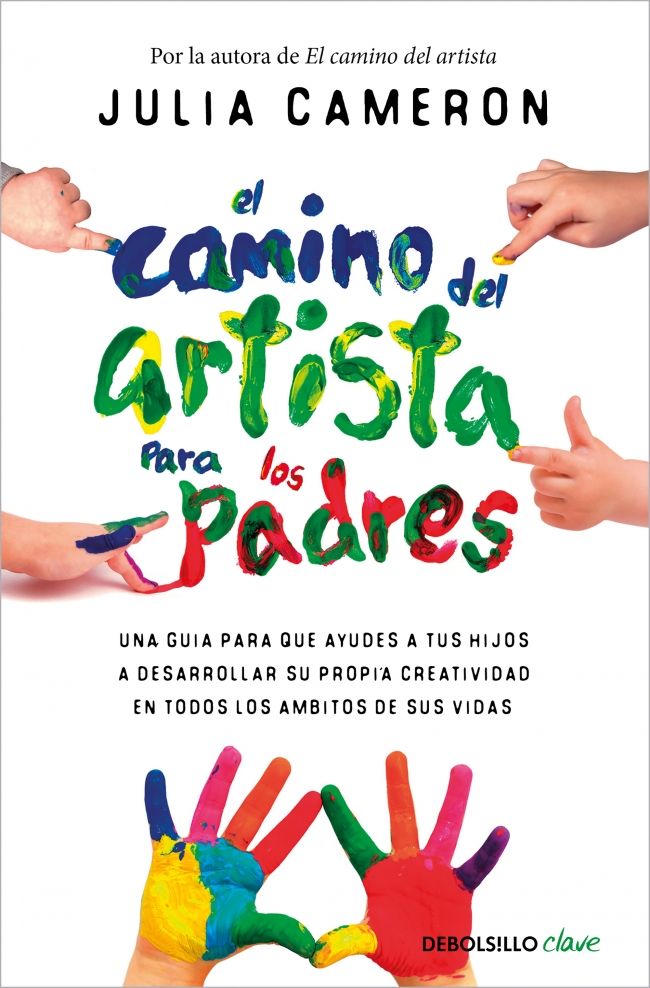
In 2013, thirty-seven years after her daughter Domenica was born, Julia Cameron published the book she perhaps should have written a long time ago. The Artist's Way for Parents It is an honest and pragmatic adaptation of the original method to the specific reality of parenting. Her target readers are not single artists with free time. They are fathers and mothers who want to keep their own creative lives alive while raising someone who requires them twenty-four hours a day — and who, in parallel, want to cultivate their children's natural creativity without turning the house into a forced art studio.
book summary
- Year: 2013. Cameron was 65 years old and had been pregnant for 37 years.
- Structure: 12 weeks, but with profound adaptations of the practices so that they work with young children or adolescents at home.
- Autobiographical material: The book is filled with true stories of Cameron raising Domenica in the '80s — as a single mother, recovering from alcoholism, moving between cities.
- Double focus: how to protect your own creativity as a parent, and how to cultivate your children's without forcing it.
- Adapted tools: "morning pages" short version, joint or postponed "dates with the artist", "family creative games."
The honesty of the book
Cameron opens the book with a confession that sets the tone: "during the years I was raising Domenica, there were whole weeks when I didn't do my morning pages. Not because I didn't value them — because there was literally no time. And most importantly: that was okay. Early motherhood is a phase where part of the method has to be adapted, not applied with military rigor".
This recognition — that the method has to adapt to reality, not the other way around — is liberating for thousands of fathers and mothers who had been feeling like failures for years because they could not follow the original program. It is not failure. It's real life. And the book is entirely dedicated to offering viable versions of the practices in real conditions.
The morning pages in motherhood
Cameron offers several adaptations for the morning pages. The first: reduce the target when necessary. Three full pages are ideal — but if you have a baby who wakes up at 6, one page is better than zero. Half a page is better than nothing. Writing three lines while the baby eats breakfast counts as practice that day.
The second adaptation: change the moment if necessary. They don't have to be before dawn. They can be during the baby's nap. During the first half hour at work if you take the child to daycare. In the bathroom with the door closed if necessary. The moment matters less than the consistency.
The third — and most important — forgive the interruptions. In intense phases of parenting, you are going to fail many days. Cameron insists: don't count it as a failure. Failure is not skipping days. Failure is using a skipped day as an excuse to quit forever. If you skip a day, you come back the next. If you skip a week, you come back the following Monday. The practice lives on as long as you keep coming back.
Family appointments with the artist
The date with the original artist is, by definition, an individual activity of two hours alone. That, for a parent of young children, may be logistically impossible. Cameron proposes three adapted versions.
Version 1: postponed appointment. If you can't make the appointment this week, reserve it for Saturday two weeks from now, when your partner or grandma is watching the kids. You commit to the calendar. It's better than not doing any.
Version 2: date with the artist as a family. Sometimes you can adapt the concept: going out with the children to something aesthetically nourishing. A museum. A book fair. An outdoor concert. The key is that the activity nourish you too, not just children. The ball park does not count. A modern art museum with children's activities, yes.
Version 3: daily small quote. Instead of two hours a week, twenty minutes a day. A short walk alone. Listen to a complete song without interruptions. Flipping through an art book on the couch. If you can't afford the big two hours, you accumulate small ones.
Cultivate children's creativity without forcing it
Half of the book is dedicated to the other side: how to encourage creativity in your children without it becoming an obligation. Cameron is specific about what no What you have to do: don't turn creative activities into homework, don't compare your children with other children, don't force talents that they don't want to develop, don't project onto them the creative dreams that you didn't fulfill.
And it is specific in what does work: frictionless materials available (paper, paints, cheap instruments on display, not locked in closets), unscheduled time (deliberate boredom on weekends, without screens, so that their own games emerge), natural modeling (let them see you write, paint, play — without lecturing about it), and respect for children's work (hang your drawings with the same care with which you would hang a gallery piece).
"Children are artists by default. The parent's job is not to make them artists — it is not to take away the artist they already are."
Julia Cameron · The Artist's Way for Parents · 2013autobiographical material
What makes this book unique within Cameron's oeuvre is the amount of autobiographical material. Cameron tells, for the first time in detail, what her years as a single mother with Domenica were like in the eighties. Removals. Economic crises. His own sobriety being monitored by his young daughter. The children's notebooks that Domenica wrote at her side. Appointments with the artist when he could. The years when I couldn't.
For readers who only knew Cameron as the masterful author of the method, this book shows her as what she also was: an imperfect woman raising a girl alone in complicated conditions, applying her own method when she could and adapting it when she couldn't. That more human and less doctrinal version is probably what makes the book connect especially with readers who need to see that the method works in real conditions, not just ideal conditions.
Bilingual technical data sheet · Technical data
English edition
Publisher: Jeremy P. Tarcher / Penguin
Year: 2013
Pages: 272
ISBN: 978-0399162480
Language: English
Spanish edition
Editorial: various editions in Spanish
Year: 2013 (original); translation available in various editions.
Pages: 272 (approx.)
Spanish translation: available from multiple publishers.
Language: Castilian
Historical context · Historical context
Cameron wrote this book at age 65, with her daughter Domenica already adult and independent (thirty-seven years old). The book is, in large part, the letter Cameron couldn't write to his own mother and the manual he wishes he had when he was raising Domenica in the eighties. The autobiographical material is abundant: she recounts for the first time in detail her years as a single mother, her sobriety supervised by a young daughter, the moves between Chicago and New York, the notebooks that Domenica wrote at her side imitating her mother.
Specific adaptations · Specific adaptations
Cameron is honest: the original method was difficult to apply with young children. Morning pages at 6am with a baby who wakes up every two hours was impossible. Appointments with the artist of two hours alone were an impossible luxury. The book offers specific adaptations — not compromises, adaptations:
- Reduced morning pages: A page or half a page is valid when the phase demands it.
- Flexible moment: They don't have to be before dawn. During the nap. In the first half hour of work.
- Forgive yourself interruptions: skipping days is not failure. Failure is using a skipped day as an excuse to quit.
- Appointments with the artist postponed: If it is not possible this week, it is reserved for two weeks from now.
- Family quotes: outings that also aesthetically nourish the adult.
- Daily Small Quotes: 20 minutes a day instead of 2 hours a week.
Cultivating creativity in children without forcing it Cultivating creativity in children without forcing it
The second half of the book is dedicated to the other side. Cameron is clear about what no It works: turning creative activities into homework, comparing children with other children, forcing specific talents, projecting the father's unfulfilled dreams onto the children. And she is clear about what does work: materials available without friction (paper, paints, instruments in sight), unscheduled time (deliberate boredom), natural modeling (watching the parent create), and respect for the child's work (hanging it with the same care as a gallery piece).
Frequently Asked Questions · Frequently Asked Questions
Does it work if my children are already teenagers? / Does it work if my children are already teenagers?
Yes, with adaptations. The book is intended for parents ages 0-12, but the essential ideas (unforced creativity, natural modeling, respect for the work) apply to any age. For teens specifically, Cameron recommends supplementing with Letters to a Young Artist.
Is it suitable for single parents? / Does it work for single parents?
Absolutely — Cameron wrote this knowing that many readers are single parents. Her own experience raising Domenica as a single mother is central material in the book.
Can I do it with my partner? / Can I do it with my partner?
Yes, and Cameron recommends it. Many couples work on it in parallel with shared readings and weekly conversations.
What if my child does not show interest in creative activities? / What if my child shows no creative interest?
Cameron argues that this is almost never true — it just hasn't been found. su half. The exercise is to offer variety (not force) until you notice where the child gets hooked on his own.
Is there a Spanish edition? / Spanish edition?
There are several Spanish editions circulating with variable titles. Search 'The Artist's Way for Parents' or 'The Artist's Way for Parents' in digital bookstores.
Is it only for mothers? / Is it only for mothers?
No. Cameron uses 'parent' deliberately — fathers and mothers. Male parents find the book equally useful, although the proportion of female readers is higher due to cultural patterns of non-fiction reading.
Bilingual glossary · Bilingual glossary of key terms
| English | Spanish | Meaning |
|---|---|---|
| creative parenting | Creative parenting | Raise without extinguishing the child's natural creativity. |
| Default artist | Default artist | Every child is born with active creativity. |
| Undoing the artist | Undo the artist | The everyday messages that extinguish children's creativity. |
| Permission to play | Permission to play | Explicit parental permission to spend time on non-productive play. |
| Modeling | Modeling | Let the children see their father write, paint, touch. |
| Creative clutter | creative disorder | Accept that the house with children they create is not aesthetically perfect. |
| Boredom as fuel | Boredom as fuel | Deliberate boredom activates children's creativity. |
| Artist's date with kids | Date with the artist with children | Adaptation when individual appointment is not possible. |
| Home as studio | House as a studio | Organize the space so that the materials are accessible. |
| Respectful display | Respectful exhibition | Hang children's work with the care of a gallery piece. |
How to get the book · How to get the book
- Original English edition: The Artist's Way for Parents. Available from Penguin Random House, Amazon, Apple Books, and Barnes & Noble. Also in independent bookstores and public libraries in the United States, United Kingdom, Canada and Australia.
- Spanish edition: The Artist's Path for Parents. Search in general bookstores (Casa del Libro, FNAC, El Corte Inglés), on Amazon Spain/Latin America and in independent bookstores. Also available in digital format (Kindle, Kobo, Apple Books).
- Audiobook: Most of Julia Cameron's books have an audiobook version on Audible (English) and some editions on Storytel (Spanish).
- Libraries: Cameron's works are in most Spanish-speaking public libraries with a digital lending service (eBiblio in Spain, BiblioBoard in Latin America).
- Second hand: IberLibro, AbeBooks, Wallapop and eBay usually have used copies at better prices. For out-of-print books, it is sometimes the only way.
Take the complete Artist's Path course
Based on the original book by Julia Cameron. 12 structured weeks. Free. In Spanish.
Start the course