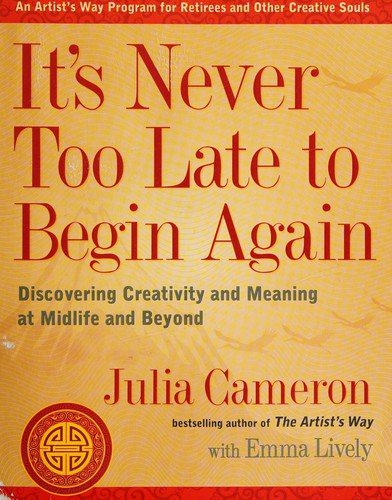
In 2016 Julia Cameron was 68 years old. His daughter Domenica was 40. The original book turned 24. And Cameron, who had been receiving questions from readers all his life about whether the method was useful for older people, finally decided to dedicate an entire book to them. He titled it with characteristic honesty: It's Never Too Late to Begin Again — It's never too late to start again. They are twelve weeks, like the original book, but designed specifically for people who have more life behind them than in front of them and want their remaining years to be the most creative of all.
book summary
- Year: 2016. Cameron publishes it at 68 years old.
- Target audience: retired people or people about to retire, widows, divorced people at a mature age, liberated caregivers, professionals over 60 who want to reinvent themselves.
- Structure: 12 weeks with morning pages + appointment with the artist + weekly walk (the three base practices).
- New central tool: the "memoirs" — a few extra weekly pages dedicated to writing down specific memories by decade. Not to publish — to catalyze creativity recovering what life has accumulated.
- Book promise: The second half of life is not a consolation — it is, if you know how to take advantage of it, the most creatively rich time that exists.
Why a specific book for the second half
Cameron had resisted the idea of writing a "grown-up" book for years. Its fundamental thesis — that creativity is a universal right independent of age — seemed to contradict segmentation. But two things changed her mind. First: the recurring letter from thousands of readers over 60 who felt that the original book spoke to them about things (marriages, careers, mid-30s panics) that were no longer their central concerns. Second: your own experience. At 60, Cameron realized that his own practice had changed. The morning pages remained the same. But the themes that came out of them were different. The fears were different. Priorities too.
So he wrote a book that is, in essence, The Artist's Way with the emotional temperature of someone who has already lived a lot. It's less about "finding out who you are" and more about "finishing what you started." He talks less about "future ambitions" and more about "long-delayed projects." It speaks less about "value" and more about "dignity." And he dedicates entire chapters to topics that the original book did not touch on: loneliness after a loss, creativity with physical limitations, the legitimate desire to leave a legacy, the relationship with one's own adult children.
The central tool — the "memoirs"
The great methodological novelty of the book is the introduction of some additional weekly pages dedicated to writing down memories. Cameron calls them "memoirs" — memories. They are not autobiography in the literary sense. They are concrete memories, written for decades, as material for the present.
The instruction is specific: each week, in addition to the daily morning pages, the reader writes a specific scene from his life. A specific afternoon. A trip. A conversation. A job. A house. A person. Not summary — scene. What was seen, what was smelled, what was felt, what was said. Four to six pages.
The objective is twofold. On a practical level, recovering forgotten material — material that the brain has stored but that daily life does not activate. On a creative level, discover the recurring themes in your own life. When you accumulate twenty or thirty of these scenes, patterns appear: the characters who return, the places that matter, the defining moments. These patterns are, almost always, the stuff of what you should be creating now.
"Your seventies are not a dusty basement. They are a full warehouse. The book you have come to write may already exist in pieces — you just have to go look for them."
Julia Cameron · It's Never Too Late to Begin Again · 2016Some specific themes of the book
Grief and creativity
One of the most moving chapters in the book deals explicitly with grief. Cameron recognizes that many readers in her age range have lost their partners, their sisters, their friends. It proposes a specific use of the morning pages as a vehicle for processing grief. It does not replace grief or shorten it — but it gives it a channel. The page accompanies in a way that neither psychotherapy nor support groups can replicate: silently, every morning, without witnesses.
Physical limitation as a factor
The book also addresses — without drama — the reality that many older readers have physical limitations that younger readers do not have. Arthritis in the hands (makes handwriting difficult). Reduced mobility (makes walking difficult). Tired eyesight (makes reading difficult). Cameron offers adaptations for each. Handwriting can be substituted for dictation if the arthritis is severe. The walk can be done on a treadmill, or even sitting with arm movements. The method is flexible. What is essential is the discipline of the time dedicated, not the exact form.
The relationship with adult children
Another important chapter explores how motherhood changes when children are adults with lives of their own. Most mothers experience, upon retiring from active parenting, a mixture of freedom and disorientation. Who am I now that I am no longer the mother of a child who needs me every hour? Cameron suggests using morning pages specifically to identify what you've always wanted to do when your kids were independent — and start doing it now.
Legacy
Cameron dedicates several chapters to the desire — totally legitimate — to leave something. Not in the sense of fame. In the sense of transmission. A book for the grandchildren. A collection of organized photographs. A series of paintings. A documented house. Legacy, Cameron argues, is a higher form of creativity because its beneficiary is not you — it is someone you have not even met yet and whose face you cannot imagine.
Which reader is ideal for this book?
If you are 55 or older and feel that your life is entering a new phase — because you are retiring, because your children are leaving, because you are widowed, because you separated late, because you sold the company, because you finally have time — It's Never Too Late to Begin Again It's the book. It is not consolatory. It's practical. It proposes twelve weeks of concrete work and, by the end, you hope to have at least three new projects underway.
If you are under 50, the book will seem fine but not vibrant. It is written for another emotional age. Keep the original book. When you reach 55, you come back to this one.
And if you're 80 and think it's too late — that's precisely the diagnosis the book is designed to dismantle. Cameron names several painters who started after 75. Writers who published their first novel at 82. Actresses who won their first award at 91. The pattern is clear: there is no age at which creativity closes the door. There is only an age at which we decide to close it. And that decision, like all, is revocable.
Bilingual technical data sheet · Technical data
English edition
Publisher: Jeremy P. Tarcher / Penguin
Year: 2016
Pages: 272
ISBN: 978-0399176579
Language: English
Spanish edition
Editorial: Aguilar (some Latin American editions)
Year: 2016 (original); translation available in various editions.
Pages: 272 (approx.)
Spanish translation: available from multiple publishers.
Language: Castilian
Historical context · Historical context
Cameron was 68 years old when he published this book in March 2016. It was a natural time. She had been receiving correspondence for decades from older readers asking if the method was useful for them. And she had been practicing an adapted version for years with her own elderly students in workshops in Santa Fe and New York. The book is written, therefore, based on very concrete empirical evidence: Cameron had tested it with hundreds of women and men aged 60+ before writing it down.
The personal also mattered. Two years earlier he had lost several close friends. His mother had passed away. And Cameron was, as she herself says in the prologue, "in the phase where every month you discover that another important person is no longer there". That acute awareness of finitude — without drama, with acceptance — permeates the book. It is not a book about the end. It is a book about all that remains to begin.
The "memoirs" tool unpacked · The memoirs tool unpacked
The central methodological novelty of the book is the introduction of the memoirs — weekly sessions specifically dedicated to writing down memories for decades. It is not literary autobiography. It is not narrative therapy. It is raw material for present creativity.
Cameron's instruction is precise: each week, in addition to the morning pages, the reader dedicates one hour to write a specific scene of his life. An afternoon, a trip, a conversation, a job, a house, a person. No summary — scene. What was seen, what was smelled, what was felt, what was said. Four to six handwritten pages.
The objective is twofold. Retrieve forgotten material — material that the brain has stored but daily life does not activate. and discover the recurring themes of life itself. When twenty or thirty of these scenes are accumulated, patterns emerge. The characters that return. The places that matter. The decisions that defined. These patterns are almost always the stuff that today's creative projects should be made of.
The 12 weeks adapted for the second half · 12 weeks adapted for the later chapter
The twelve weeks maintain the architecture of the original book but with recalibrated themes:
- Reclaiming a sense of surprise · Reclaiming a sense of wonder — see the world again as if you didn't know it.
- Freedom · Freedom — free yourself from obligations that no longer apply.
- Connection · Connection — with oneself and with those who remain.
- Purpose Purpose — redefined without race logic.
- Honesty Honesty — about what one is now and what one is not.
- Humility · Humility — recognize what is neither known nor controllable.
- Resilience · Resilience — how to survive the blows of this phase.
- Joy · Joy — yes, at this age too; with more reason.
- Movement Motion — physical and creative, in that order.
- Perseverance Perseverance — in the sense of Finding Water, applied to the last phase.
- Faith Faith — not necessarily religious. Faith in the process.
- Grace · Grace — the umbrella theme.
Critical reception · Critical reception
This book had one of the best receptions of Cameron's last fifteen years. AARP (the great american association of people over 50) recommended it repeatedly. Oprah's Book Club He mentioned it in his newsletter. Publishers Weekly He reviewed it with unusual warmth for a self-help book. And especially the book found a new audience that Cameron hadn't reached before: recently retired women, widows, mature divorcees, liberated caregivers.
In Spain and Latin America the reception has been slower for cultural reasons — the "boomer" as a category of reader is not as strong in the Hispanic market — but the book has gained traction in recent years, especially during and after the pandemic, when many mature readers rethought their next years.
Frequently Asked Questions · Frequently Asked Questions
What age is this book for? / What age is this book for?
Cameron writes it with 60+ in mind but in practice it works from 55 onwards. The important thing is not the chronological age but the life phase: retirement, empty nest, loss of a partner, return to creativity after decades of responsibilities.
Does it work if I am 45 years old? / Does it work if I'm 45?
Probably yes in parts — concepts about memory and patterns are useful at any age — but some topics (retirement, adult children, finitude) may feel premature. Our recommendation: if you are under 55, read Walking in This World or Finding Water first.
Do you have to be retired to do it? / Do I need to be retired?
No. Cameron wrote it knowing that many readers are in a transitional phase — semi-retired, reducing hours, thinking about retiring soon. The book works at any point along the way to the next phase.
Are 'memoirs' to be published? / Are the memoirs meant for publication?
No. Cameron is explicit: they are private material to activate current creativity. Some readers later use them as a basis for a publishable literary memory, but that is not the purpose of the exercise. The value is in writing them, not publishing them.
How much time per day does the book ask for? / How much time per day does it require?
The same as the other books (morning pages + appointment with the artist + walk) PLUS an hour a week for the memoir. Approximately 45-60 minutes per day plus 3-4 hours off per week. Reasonable for most retired phases.
Does it work if I am not in good physical health? / Does it work with limited physical health?
Yes. Cameron dedicates a chapter to adaptations: writing with arthritis (can be dictated), reduced walks (can be indoor), adapted artist appointments (can be virtual). The method is flexible.
Is there a translation into Spanish? / Is there a Spanish translation?
Yes, some Latin American editions have it as It's never too late to start again. It also circulates in a digital version.
Is it a book about death? / Is it about death?
No. It is a book about the life that remains — sometimes decades — between now and death. It touches on finitude honestly but it is not its central theme. Its central theme is everything that can still be started.
Bilingual glossary · Bilingual glossary of key terms
| English | Spanish | Meaning |
|---|---|---|
| Never too late | It's never too late | Central thesis of the book. |
| Memoirs | Memoirs | Weekly exercise of writing specific scenes from one's own life. |
| Second chapter | Second chapter | Metaphor for the second half of life. |
| wonder | Surprise/astonishment | Ability to look at the world as if you didn't know it. |
| Legacy | Legacy | Not in the sense of fame — in the sense of transmission to those who come. |
| Reinvention | Reinvention | Start again without deleting the previous one. |
| late bloomer | late flowering | Person who produces his best work after 60. |
| Elders as artists | Seniors as artists | Cameron's thesis: maturity is a raw material, not an obstacle. |
| Grandchild as believing mirror | Grandson as a believing mirror | The unique role of grandchildren in the creative permission of elders. |
| Digital inheritance | Digital heritage | What is left written for future generations. |
How to get the book · How to get the book
- Original English edition: It's Never Too Late to Begin Again. Available from Penguin Random House, Amazon, Apple Books, and Barnes & Noble. Also in independent bookstores and public libraries in the United States, United Kingdom, Canada and Australia.
- Spanish edition: It's never too late to start again. Search in general bookstores (Casa del Libro, FNAC, El Corte Inglés), on Amazon Spain/Latin America and in independent bookstores. Also available in digital format (Kindle, Kobo, Apple Books).
- Audiobook: Most of Julia Cameron's books have an audiobook version on Audible (English) and some editions on Storytel (Spanish).
- Libraries: Cameron's works are in most Spanish-speaking public libraries with a digital lending service (eBiblio in Spain, BiblioBoard in Latin America).
- Second hand: IberLibro, AbeBooks, Wallapop and eBay usually have used copies at better prices. For out-of-print books, it is sometimes the only way.
Take the complete Artist's Path course
Based on the original book by Julia Cameron. 12 structured weeks. Free. In Spanish.
Start the course