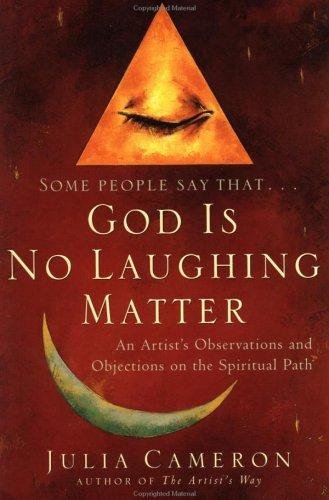
In the year 2000, eight years after The Artist's Path, Julia Cameron published the book in which she finally addressed head-on the spiritual dimension that permeated all of her previous work. It is titled God Is No Laughing Matter: Observations and Objections on the Spiritual Path — God is no Joke: Observations and Objections to the Spiritual Path. It is not a book of Catholic doctrine. It is not a new age book. It is a collection of short essays, sometimes autobiographical, sometimes aphoristic, written from active faith and at the same time from active doubt.
book summary
- Year: 2000.
- Format: short essays, 2-6 pages, organized but not rigidly structured.
- Tone: colloquial, with occasional humor, deeply honest about ambivalence.
- Thesis: The spiritual life cannot be separated from creative work, but it does not require adherence to any specific tradition.
- Who is it for: believers with doubts, agnostics with curiosity, atheists willing to read someone who argues from the other side with respect.
Why Cameron wrote this book
During the 90s, while The Artist's Path became a phenomenon, Cameron received two diametrically opposed types of criticism. Secular readers reproached him for having too much spiritual language—"the Creator," "the divine channel," "creative grace." Religious readers reproached him for saying that his language was too soft, too ecumenical, too little committed to a specific doctrine.
Cameron decided in 2000 to publish a book that directly addressed his own position. Not evangelical. No new age posture. A spirituality that is worked on, critical, with built-in doubt, and radically focused on how the act of creating connects with something bigger than oneself. whatever you call it.
The tone of the book
One of the things that surprises when reading God Is No Laughing Matter It's the humor. Cameron — raised by Jesuits, trained in irony — does not take God with dramatic solemnity. He writes with a mixture of reverence and irreverence that is more reminiscent of Chesterton or Anne Lamott than the usual spirituality manuals. There are entire chapters dedicated to specific frustrations with the idea of God. To prayers that have not been answered. To periods of spiritual dryness. To the temptation to stop believing completely.
And precisely because of that honesty, the book works even for readers who don't share his faith. Cameron isn't preaching — he's thinking out loud. And what he thinks, out loud, is articulate and generous with positions other than his own.
"My experience is that God — or what I call it — answers when you ask, not when you demand. And He answers in the language of small synchronicities, not in that of spectacular miracles."
Julia Cameron · God Is No Laughing Matter · 2000Central themes
The book visits several areas: the relationship between prayer and creativity, how faith operates in periods of doubt, what spiritual tradition works for what type of person, how to talk about spirituality without falling into the clixé, silence as a central practice, the problem of evil for a believer, and — perhaps most importantly — how the creative life requires some kind of metaphysical support even if one is not formally religious.
The last idea is the underlying thesis. Cameron argues — with empirical evidence from his workshop years — that artists who don't have some kind of "larger anchor" tend to burn out sooner. It does not require a specific religion. It could be nature. It may be a sense of belonging to an artistic lineage. It may be the concept of humanity. The essential thing is that there is something bigger than one's own ego that sustains the work when the ego falters. Without that something, doubt eats up the artist.
When to read it?
If you are in a phase of your life in which spiritual questions have become important—out of grief, out of life change, out of sincere curiosity—this book is a good companion. It is not Cameron's most practical book. It is probably the most intimate. And it is the most honest about the least articulable territory of all his work.
Bilingual technical data sheet · Technical data
English edition
Publisher: Jeremy P. Tarcher/Putnam
Year: 2000
Pages: 240
ISBN: 978-1585420735
Language: English
Spanish edition
Editorial: Gaia Editions
Year: 2000 (original); translation available in various editions.
Pages: 240 (approx.)
Spanish translation: available from multiple publishers.
Language: Castilian
Historical context · Historical context
Cameron published this book in 2000, on the threshold of the new millennium. He had been receiving opposing criticism for eight years The Artist's Path: secularists complained about spiritual language; The religious complained that this language was too soft. God Is No Laughing Matter was his sincere response to both groups. Not an apologetic book. Not a proselytizing book. A book of short essays written from active faith and active doubt simultaneously.
The tone of the book · The tone of the book
The first thing that surprises you when reading it is the humor. Cameron — raised by Jesuits, trained in irony — does not take God with dramatic solemnity. He writes with a mix of reverence and irreverence reminiscent of G.K. Chesterton or Anne Lamott. There are chapters dedicated to specific frustrations with the idea of God, to unanswered prayers, to periods of spiritual dryness, to the temptation to stop believing altogether. That honesty makes the book work even for readers who don't share his faith.
Frequently Asked Questions · Frequently Asked Questions
Is it a book only for Christians? / Is it only for Christians?
No. Cameron was raised Catholic but her adult spirituality is ecumenical. The book cites Christian, Jewish, Sufi, Buddhist and Hindu traditions. Any reader with a spiritual inclination — or sincere curiosity — will find material.
What if I am an atheist? / What if I'm atheist?
Cameron dedicates explicit chapters to non-believing readers. The book invites us to dialogue, not to convert. Many atheist readers read it as an essay on inner states, not as theology.
Is it a book about creativity? / Is it about creativity?
Indirectly yes. Cameron argues that the creative act requires some kind of anchor larger than the individual ego, be it formal religion or nature or humanity. The book explores what are the possible anchors.
Is there a Spanish edition? / Spanish edition?
Yes, in Gaia Editions like God is not a joke or similar — several editions have circulated with variations of the title.
Is it related to The Artist's Way? / How does it relate to The Artist's Way?
It explicitly develops the spiritual component that the original book only suggested. If you were interested in 'the Creator' and 'grace' from the original book, this book goes into depth without forcing specific doctrine.
How long does it take to read? / How long does it take to read?
The essays are short (3-6 pages). Cameron recommends reading one a day for about two months, not devouring the book. The effect is cumulative.
Bilingual glossary · Bilingual glossary of key terms
| English | Spanish | Meaning |
|---|---|---|
| No laughing matter | It's not a joke | Title — double meaning: serious and humorous. |
| Spiritual skepticism | Spiritual skepticism | Position of active doubt within the faith. |
| Ecumenical spirituality | Ecumenical spirituality | Open to multiple traditions without adhering to one. |
| Dry period | Dry period | Phase in which prayer or practice produces no response — traditional mystical term. |
| Small synchronicities | Small synchronicities | The language in which, according to Cameron, the divine answers. |
| Prayer as practice | Prayer as practice | Prayer not as a request but as a contemplative discipline. |
| Silence as response | Silence in response | When there is no explicit response, silence itself is information. |
| Observation over objection | Observation over objection | The tone of the book — observe before arguing. |
| Humor in faith | Humor in faith | Against the excessive solemnity of institutional religion. |
| Faith and doubt | Faith and doubt | Not opposites — complementary in adult life. |
How to get the book · How to get the book
- Original English edition: God Is No Laughing Matter: Observations and Objections on the Spiritual Path. Available from Penguin Random House, Amazon, Apple Books, and Barnes & Noble. Also in independent bookstores and public libraries in the United States, United Kingdom, Canada and Australia.
- Spanish edition: God is no joke: observations and objections to the spiritual path. Search in general bookstores (Casa del Libro, FNAC, El Corte Inglés), on Amazon Spain/Latin America and in independent bookstores. Also available in digital format (Kindle, Kobo, Apple Books).
- Audiobook: Most of Julia Cameron's books have an audiobook version on Audible (English) and some editions on Storytel (Spanish).
- Libraries: Cameron's works are in most Spanish-speaking public libraries with a digital lending service (eBiblio in Spain, BiblioBoard in Latin America).
- Second hand: IberLibro, AbeBooks, Wallapop and eBay usually have used copies at better prices. For out-of-print books, it is sometimes the only way.
Take the complete Artist's Path course
Based on the original book by Julia Cameron. 12 structured weeks. Free. In Spanish.
Start the course