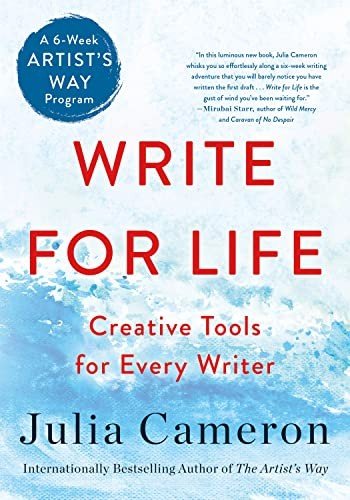
In 2023, at 75 years old, Julia Cameron published a shorter than usual and more technical book. He titled it Write for Life: A Toolkit for Writers from the Author of The Artist's Way. Six weeks. Each one focused on a specific phase of the process of writing a long project — idea, structure, first draft, pause, revision, delivery. It is the most strategic book of all his work. It does not talk about permission to write (that topic was covered in The Right to Write). Talk about something more specific and more urgent: how not to abandon what you have started.
book summary
- Year: 2023. A book of maturity, written at 75 years old.
- Structure: 6 weeks, one for each phase of writing a project.
- New tool: el "companion-witness" — a companion-witness. Someone with whom you commit to sending what you write every week, not so that they judge it, but so that there is a witness.
- Focus: finish. Not starting, not improving, not shining. Finish.
- Who is it for: people who start many writing projects and finish few.
The problem the book solves
Cameron opens the book by identifying a pattern that, after decades of giving workshops, she knew by heart: talented writers, with ideas, with the discipline to write morning pages every day — but unable to finish a long project. Abandoned novels in chapter eight. Memories that never leave the third act. Essay books that lose momentum when twenty percent remains.
The temptation is to say "they lack discipline." Cameron rejects that explanation. They don't lack discipline — if they did, they wouldn't be writing morning pages every morning. They lack strategic structure for long projects. Daily discipline is a necessary condition. But it is not enough. An 80,000-word project also requires: planning, tolerance for mid-phase ambiguity, public commitment, scheduled review windows, and a way to close that doesn't depend on whether you "feel ready."
The six weeks
Week 1 — Idea. Not one, many. Cameron proposes a list of fifty possible project ideas, without censorship. From there five are chosen. Of those, one. You don't choose the "best" one — you choose the one that more uncomfortable, because it is usually the most alive.
Week 2 — Structure. A complete skeleton of the project on a single sheet. Twenty to thirty bullets. You don't write the book in week two — you map it. Cameron insists that the structure of day two can change when you get to the middle, but without it you're lost. The skeleton is GPS, not law.
Week 3 — Aggressive first draft. The largest possible volume is written in the week. Aim for 5,000-10,000 words. Unedited. Without rereading. Without correcting spelling. Raw production only. Cameron quotes the mantra: "you can't review a blank page" — you can't review a blank page.
Week 4 — Deliberate pause. Nothing is written about the project. He dedicates himself to reading other authors of the same genre, to consuming inputs, to processing what is written in the backpack of the subconscious. This week is counterintuitive — many writers skip it thinking it's a waste of time. Cameron insists: it is precisely where what you are going to review later is consolidated.
Week 5 — Structural review. Now it is reread. What is left is marked. What is missing is identified. Material is moved. It is rewritten in layers — first large structure, then scenes, then phrases. Cameron offers a specific layered method.
Week 6 — Delivery. It is defined who is given the first reading. It is sent. No apologies. Without preparing the reader for how imperfect it is. The act of delivering closes the psychological cycle and prepares the writer for the next.
The companion-witness
The new tool in the book is the companion-witness: a trusted person — not an editor, not a critic, not an expert — who is sent each week a short summary of what has been done. Two or three sentences. "This week I wrote 4,000 words of chapter three. I got stuck on the sister character. I'll leave it for next week."
The witness does not have to answer anything profound. A "received, continue" is enough. Your value is not in the feedback — it is in the existence of the record. The fact that someone else knows that you worked on the book this week makes abandoning it have a small social cost. And that minimal friction is, for many writers, the difference between finishing and not finishing.
"A witness doesn't save you. But it forces you not to disappear in silence. And most abandoned projects are abandoned in silence."
Julia Cameron · Write for Life · 2023Who is it for?
If you've had "the novel" or "the book" in your head for years and never get past chapter three, this book is written for you. Six weeks. Very specific. Very tactical. Less philosophy, more procedure. When you're done, you'll probably have a whole first draft. Not perfect. But whole. And a complete first draft is—as Cameron has insisted for thirty years—infinitely more valuable than ten brilliant ideas that were never written down.
Bilingual technical data sheet · Technical data
English edition
Publisher: St. Martin's Essentials
Year: 2023
Pages: 208
ISBN: 978-1250875433
Language: English
Spanish edition
Editorial: Spanish editions available on digital platforms
Year: 2023 (original); translation available in various editions.
Pages: 208 (approx.)
Spanish translation: available from multiple publishers.
Language: Castilian
Historical context · Historical context
Cameron published this book at the age of 75, with an observation accumulated over four decades: many talented people start projects and abandon them. Not for lack of talent or ideas — for lack of completion strategy. Write for Life is, in large part, the book that compiles what Cameron had taught in advanced workshops on finish what you start.
There is also a cultural context. The era of newsletters, blogs, self-publishing platforms like Substack and Medium, had created an ecosystem in which everyone had a platform to publish but very few people had long finished projects. Cameron wanted to offer a specific tool for that gap.
The six weeks · The six weeks
Each week corresponds to a specific phase in the process of a long project: idea, structure, aggressive first draft, deliberate pause, structural review, delivery. The format is more tactical than in Cameron's other books. Less philosophy, more procedure.
The companion-witness · The companion-witness
The new tool in the book is the companion-witness: a trusted person — not an editor, not a critic, not an expert — to whom a short summary of the progress is sent each week. Two or three sentences. Your response doesn't have to be profound: a "received, continue" is enough. Its value is not in the feedback but in the existence of the external registry. Quietly abandoning is no longer free when someone else is aware.
Frequently Asked Questions · Frequently Asked Questions
Is it for writers who already write or for beginners? / Is it for writers who already write?
For both, but especially useful for those who already write but don't finish. If you haven't started writing regularly yet, The Right to Write is a better starting point.
Is it suitable for non-literary projects? / Does it work for non-literary projects?
Yes. The six phases (idea, structure, draft, pause, review, delivery) apply to any long project: thesis, research, programming, design, serial visual art. Cameron writes from the literary world but architecture is general.
What happens if I don't have companion-witness available? / What if I don't have a companion-witness?
Cameron acknowledges that not everyone has someone available. Alternatives: an online writing group, a writing coach, even a chatbot that you report to weekly. The essential thing is that there is an external record, not that there is a human on the other side.
Can it be extended more than six weeks? / Can it be extended beyond six weeks?
Yes. Cameron indicates that six weeks is a minimum viable sequence. Long projects (novels, doctoral theses) can extend each phase to several weeks. The structure is maintained; time adjusts.
Is there a Spanish edition? / Spanish edition?
The Spanish edition is available on digital platforms. It is one of Cameron's recent works, so physical distribution in Hispanic bookstores may be more limited than classic books.
Is it the same as NaNoWriMo? / Is it the same as NaNoWriMo?
Not quite. NaNoWriMo is a 50,000 word race in November with no review. Write for Life is a complete project cycle — it includes the review and delivery phase. They are compatible: some writers use November for phase 3 (aggressive draft) and then extend the other phases to the rest of the year.
Bilingual glossary · Bilingual glossary of key terms
| English | Spanish | Meaning |
|---|---|---|
| Write for life | Write to live | Book title. Writing as a vital practice, not just a professional one. |
| Companion-witness | Companion-witness | Person to whom you report weekly so as not to leave in silence. |
| Six phases | Six phases | Idea, structure, draft, pause, review, delivery. |
| Aggressive first draft | Aggressive first draft | Maximum volume week without editing. |
| Deliberate pause | Deliberate pause | Week without writing, dedicated to external inputs. |
| Structural review | Structural review | Macro changes before polishing phrases. |
| Finishing ritual | Closing ritual | Symbolic act of delivery that closes the psychological cycle. |
| Project toolkit | Project Toolbox | Subtitle of the book — collection of methods. |
| Check in layers | Review by layers | First structure, then scenes, then sentences. |
| Silent abandonment | Silent abandonment | pattern that companion-witness is designed to prevent. |
How to get the book · How to get the book
- Original English edition: Write for Life: A Toolkit for Writers from the Author of The Artist's Way. Available from Penguin Random House, Amazon, Apple Books, and Barnes & Noble. Also in independent bookstores and public libraries in the United States, United Kingdom, Canada and Australia.
- Spanish edition: Writing to Live: A Toolkit for Writers. Search in general bookstores (Casa del Libro, FNAC, El Corte Inglés), on Amazon Spain/Latin America and in independent bookstores. Also available in digital format (Kindle, Kobo, Apple Books).
- Audiobook: Most of Julia Cameron's books have an audiobook version on Audible (English) and some editions on Storytel (Spanish).
- Libraries: Cameron's works are in most Spanish-speaking public libraries with a digital lending service (eBiblio in Spain, BiblioBoard in Latin America).
- Second hand: IberLibro, AbeBooks, Wallapop and eBay usually have used copies at better prices. For out-of-print books, it is sometimes the only way.
Take the complete Artist's Path course
Based on the original book by Julia Cameron. 12 structured weeks. Free. In Spanish.
Start the course